

Introduction: Seeing Inside High Heat
Visualize attempting to gaze into a burning industrial furnace with its temperatures surpassing 1,000 degrees celsius (1,832 degrees fahrenheit). No human can survive that, and most machines would break down almost immediately, but seeing into burning industrial furnaces is crucial to many industries in order to monitor processes, guarantee safety, and uphold quality control.
This is where an ofenkamera comes in.
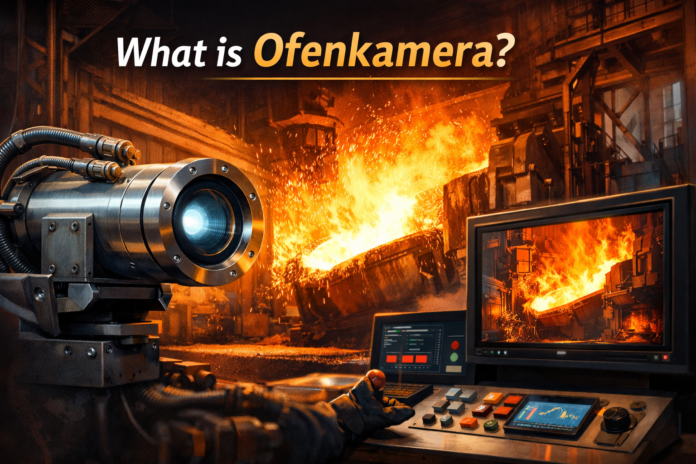
Also known as an oven camera, or a furnace camera, an ofenkamera is a specialized camera engineered to instantly and visually monitor the interiors of ovens, kilns, furnaces, and reactors in real time. It is truly an impressive device at the crossroads of engineering, optics, and heat-resistant technology that makes the invisible visible.
This guide aims to address the question, what is an ofenkamera and how is it made, how does it function, where is it implemented, what are it’s advantages and disadvantages, and what is are its possible applications in the future. This will all be explained as simply and as human as possible.
What is an Ofenkamera?
An ofenkamera is a high-temperature industrial camera designed to be used where extreme heat is an issue and where typical cameras would fail.
Simple Definition
An ofenkamera is a specialized camera system which enables the operator to view and screen certain functioning processes within industrial apparatus that are currently operational and incinerating machinery, which may include:
Furnaces
Ovens
Kilns
Incinerators
Boilers
This system is able to transmit and receive real-time images remotely without interrupting the workflow or production process and without the need to open the furnace doors.
Why the Name “Ofenkamera”?
It is an integration of two German words:
Ofen = oven or furnace
Kamera = camera
This technical terminology has permeated and is used by diverse industries around the globe.
Ofenkamera In Industry
Precision is an important facet of most industries.
In a typical furnace, the following are the repercussions of even the slightest inattention:
Equipment failure
Inferior finished products
Wastage of energy Resources
Potential Hazards
An ofenkamera caters and addresses the above by providing uninterrupted and continuous monitoring of the workflow in the furnace.
Reasons ofenkamera is used in industries
Prevention of unexpected production shutdowns
Early detection of potential workflow interruptions
Enhanced Safety of the Employees
Improvement of production processes
Decreased maintenance costs
In short, industries are able to rectify problems that would otherwise lead to serious consequences.
How Does an Ofenkamera Work?
An ofenkamera has the outward appearance of a conventional camera. However, in the inside the technology is very sophisticated.
Core Components of an Ofenkamera
Heat-resistant Retrieval Housing
The camera is enclosed in an industrial protective container or housing which is made out of stainless steel or other heat-resistant alloy composites.
Cooling System
To withstand extreme heat, the majority of Ofenkamera systems utilize:
– Water Cooling; or
– Air Cooling; or
– A Combination Of Both
This allows the internal components of the camera to maintain a safe and operational internal temperature.
High-Temperature Lens
The high-temperature lens is made of quartz glass or sapphires, which can endure extreme heat and the associated thermal shock.
Image Sensor
Modern Ofenkamera systems utilize:
– HD and Full HD Sensors
– Infrared Sensors (for environments with low visibility)
Control and Display Unit
A live video feed is transmitted to a control room to allow users to observe the environment.
Where Is Ofenkamera Used? Real-World Applications
Offenkamera can be applied to different sectors, such as:
Steel and Metal Industry
In steel production, the furnaces utilized in the steel manufacturing process run at dangerously high operational temperatures.
Ofenkamera is used to monitor:
– Flame Shape
– Flow Of Material
– Slag
This provides superior energy efficiency and ensures the metallic end product is of high quality.
Cement Industry
Cement kilns depend extensively on visual examination. With an ofenkamera, operators can:
Identify obstructions
Observe the formation of clinker
Prevent the buildup of rings
Glass Manufacturing
Glass needs to be melted uniformly. An ofenkamera assists in:
Monitoring the consistency of the melt
Identifying bubbles or defects
Keeping heat distribution constant
Power Stations
In the boilers and combustion chambers, ofenkamera systems assist in the identification of:
Instability in flames
Buildup of ash
Misalignment of the burner
Waste Incineration
In the case of incinerators, safety and compliance concern are inseparable. An ofenkamera enables constant supervision without being exposed to harmful gases.
Types of Ofenkamera Systems
Not all ofenkamera systems are the same. They differ in terms of their settings and uses.
1. Air-Cooled Ofenkamera
Utilizes compressed air
More straightforward installation
Cheaper
Optimal for medium to high temperature conditions
2. Water-Cooled Ofenkamera
Uses water in circulation
Effectively manages very high temperatures
More complicated installation
Increased maintenance
3. Infrared Ofenkamera
Functions in regions with heavy smoke
Identifies temperature variances without visible light
Comes in handy when seeing is difficult
4. Explosion-Proof Ofenkamera
Meant for risky settings
Applicable in chemical manufacturing and petroleum refining
Benefits of Using an Ofenkamera
Let’s analyze the reasons behind the worth of investing in an ofenkamera.
Key Benefits
Enhanced Safety
Employees do not have to enter hazardous regions or open furnace doors.
Increase in the quality of the product
Real-time visuals make corrections and adjustments possible.
Improvements Due to Automation
Shutdowns with a considerable cost can be avoided with the early identification of issues.
Fuel Efficiency
Fuel waste is minimized with the optimized combustion as well as the heat distribution.
Enhanced Control Over Processes
Thanks to real-time data, operators can make educated choices.
Ofenkamera’s Limitations and Challenges
Ofenkamera, like all technologies, is not without its faults.
Typical Cons
These include a high upfront investment, ongoing maintenance requirements, possible failure of cooling systems if not closely monitored, and lens obstruction by dust or slag.
Real-Life Story: How Ofenkamera Avoided a Shutdown
A cement facility had major issues with kiln blockages, causing a shutdown every week. After putting in an Ofenkamera, operators started noticing the early signs of a ring formation. They were able to adjust the temperature in real-time to prevent a buildup.
The Result?
– 30% Reduction in Downtime
– Better Product Consistency
– Thousands of Dollars Saved Every Month
This visual example speaks to the operational change that can come from Vially monitoring.
Maintaining the Ofenkamera to Ensure Longevity
The best way to ensure that your Ofenkamera receives the best care is to:
– Clean the Lens Frequently
– Continue to Monitor the Cooling Flow
– Inspect the Seals and the Housing
– Replace Any Worn Parts promptly
Good maintenance of an Ofenkamera will definitely lead to a long operational life and reliability.
Predictions relating to Ofenkamera Technology
The Ofenkamera System has a bright future ahead of it, and the following predictions are some of the most awaited:
– AI technology to detect abnormalities within an operational furnace.
– Smart Technology to Notify Staff before a Problem Becomes More Severe
– 4K Resolution and Advanced Infrared Technology that allow Better Imaging
– Seamless Integration of the Ofenkamera with the Factory Automation System
These new technologies will lead to a more predictive and intelligent system for the monitoring of industries.
Impact on Environment and Energy
By optimizing the combustion process and waste management of ofenkamera systems, the following is achieved:
Less fuel is spent
Emissions are lower
The operation is more sustainable
Therefore, more fuel-efficient productivity and environmental sustainability are achieved.
Final Thoughts: The Significance of Ofenkamera
An ofe’k’amera is not simply a camera. It has significant value as an industrial monitoring tool. It enables industries to visualize and safely view risky processes. It also helps to enhance productivity, lower operational costs, and most importantly, keep employees safe.
Ofenkamera is now integral to the industrial sector, be it steel production, cement processing, power generation, or waste management. It is truly a remarkable system. It certainly fitted the criteria of modern industry.
Predictive automation defines the next technology of ofenkamera, providing more value, improving accuracy, and increasing to the next level.
Common Queries
1. What is the purpose of an ofenkamera?
An ofenkamera is intended to provide real-time monitoring of furnaces, ovens, and kilns without exposing employees to extreme temperature conditions.
2. Can the system handle high temperatures?
Yes, most systems can handle extreme temperatures of over 1000 °C as they use advanced cooling systems and heat-resistant materials.
3. Is an ofenkamera high-priced?
Yes, it can be very costly at the beginning, but it can save significant amounts of money in the long run due to operations cost savings.
4. Which industries employ ofenkamera systems?
They are often used in the steel, cement, glass, power generation, chemical processing, and waste incineration industries.
5. What are the cooling methods for an ofenkamera?
Cooling may be accomplished with air, with water, or with a combination of the two, depending on the application.
6. How often does an ofenkamera need maintenance?
Ofenkamera systems do require maintenance, such as periodic lens cleaning, cooling system maintenance, and housing maintenance to maintain system reliability.
7. How are ofenkamera systems used in smoky environments?
Ofenkamera systems employ infrared sensors that function optimally in low visibility conditions.
8. Is the installation of an ofenkamera system complicated?
Ofenkamera systems can be complicated and require professionals to setup. After setup, systems are very easy to operate.
9. How safe are ofenkamera systems?
They are very safe and in fact enhance safety by minimizing the need for manual inspections of the areas of heat.